Is RO Water Better Than Boiled Water?  The Ultimate Guide

Is RO Water Better Than Boiled Water? The Ultimate Guide

There are many benefits to drinking reverse osmosis water instead of boiled water. RO water is filtered and removes all the impurities, while boiled water still contains some contaminants. RO water is also free of chemicals and toxins, making it a healthier choice for your body. Additionally, RO water tastes better than boiled water because it has no impurities that can make water taste bad.

When it comes to deciding whether RO water or boiled water is better for you, it depends on your needs and preferences. If you’re looking for water purely for hydration purposes, RO water is an excellent option because it contains no impurities. However, if you’re looking for water that will also provide some minerals and nutrients, then boiled water may be a better option since it contains these things. Ultimately, the best option for you depends on what you want to get out of your drinking water.

Is Boiled Water Safe?

The straightforward answer is “not entirely.” Biological organisms die when water is boiled above their temperature tolerance. Based on this principle, boiled water is claimed to be safe by the general public.

Most organisms die at 100 degrees Celsius, but the dead bodies of organisms remain as waste products. Some organisms can survive in water even at 100 degrees Celsius, like Tardigrade (Water bears), Clostridium, etc. Also, dissolved and insoluble substances in water are not removed by boiling.

On the other hand, the containers in which boiled water is usually kept are likely to be re-contaminated by germs and impurities on exposure to air.

Living organisms, dead organisms, and dissolved and undissolved substances in boiling water are undoubtedly harmful to the human body. Live organisms cause immediate disease in the human body, and dead organisms, dissolved and undissolved substances (lead, cadmium, chromium, arsenic) slowly cause various fatal diseases, including cancer.

So boiled water is sometimes sterile but not safe. Also, due to boiling, pure water evaporates and mixes into the air, and household members often suffer accidents due to boiling water. Millions of liters of gas are barns to boil water daily.  

Quick Comparision RO Water vs. Boiled Water

Boiled Water RO Water
Needs heat No need for heating
Kills 95% of microorganisms Removes 100% microorganisms
Can not remove heavy metals Removes heavy metals
Time-consuming process Instant solution process
Barn gas, fuel, or use high electricity Need a little electricity
Do not remove essential minerals Remove some essential minerals
Reduce water taste Increase water taste
Re-contamination possible by air Air-tight tank prevents re-contamination 
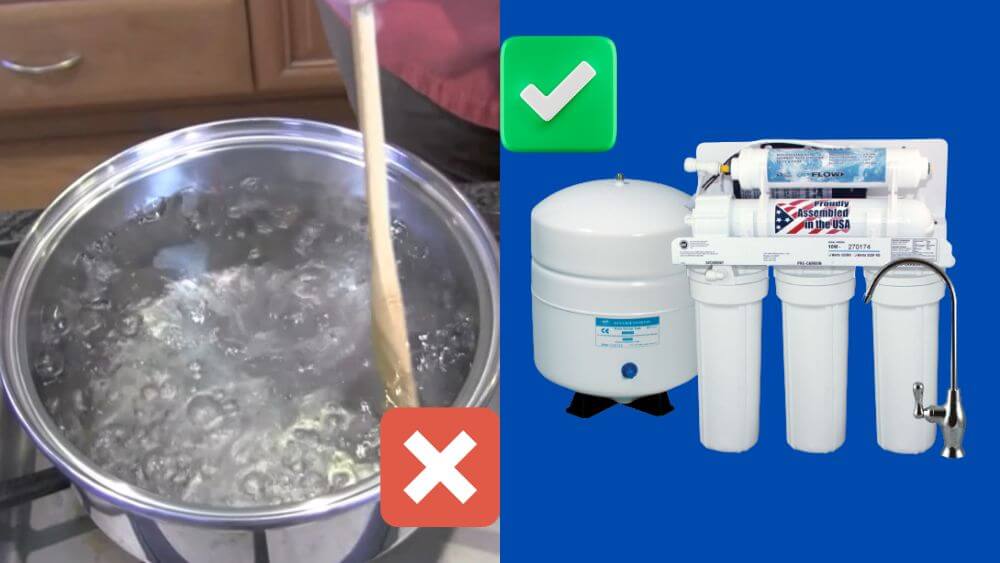
RO water is much more effective than boiling

Is Boiling Water Better Than Ro Water?

There is a lot of debate surrounding the topic of boiled water versus reverse osmosis water. Some people swear by boiling their water, while others believe RO water is the way to go. So, which is better? RO water is safer than boiled water when it comes to ensuring water safety. 

Boiled water can taste unpleasant and takes time to boil, which may not be convenient for some people. Additionally, boiled water will not remove all contaminants from your water supply – only those killed by heat.

RO water is much more effective than boiling at removing contaminants from your water supply. Additionally, it does not require heat, so it’s more convenient than boiling.

Disadvantages of Drinking Boiled Water

While boiled water is certainly better than no water, drinking it has some disadvantages. First, boiling water can be time-consuming, particularly if you’re trying to do it over an open fire. Second, boiled water can taste quite bland and flat.

This is because the boiling process drives off many dissolved gases in the water, including oxygen which gives water its characteristic freshness. Finally, boiled water can be difficult to stomach if you’re not used to it. This is because the high temperatures make it more acidic, which can irritate your digestive system.

Can We Boil Ro Water for Drinking? 

After passing through the RO membrane, water remains 100% safe. So there is no need to boil RO water. However, if you boil RO water, we have to get water from the reserve tank, which will cause re-contamination of water through the air. Finally, boiling RO water can release harmful chemicals into the air.

Can We use RO water for cooking? 

Yes, we can use RO water for cooking. Cooking with RO water will ensure food safety and improve food taste. However, a few things to remember when using RO water for drinking or cooking.

First of all, while RO water is safe to drink, it isn’t necessarily sterile. If you want to sterilize your RO water, boil it for 1-3 minutes. This will kill any bacteria or other contaminants that may be present in the water.

Second, RO water does contain some dissolved minerals. While these minerals are not harmful, they can give the water a slightly “off” taste. If you find RO water’s taste unpleasant, you can improve it by adding a pinch of salt per glass of water.

Additionally, many people prefer to store their RO water in the fridge, which helps to preserve its freshness. Overall, RO water is an excellent option for drinking and cooking – consider its mineral content and storage recommendations! 

RO water is always safe to drink.

Is Boiled Water And Ro Water the Same?

No, boiled water and RO water are not the same. Boiling water is a process of using heat to turn water into vapor, while RO water is a process of using pressure to force water through a semi-permeable membrane. While both processes remove impurities from the water, they do so differently.

Which is Better, Bottled Water Or Ro Water?

There are several reasons why drinking bottled water might be harmful. For example, plastic bottles can leach chemicals into the water over time and contain BPA (Bisphenol A), a chemical linked to cancer and other health problems.

Which is Better, Tap Water Or Ro Water?

When it comes to choosing between tap and RO water, it depends on where you live. Tap water tends to be a little safe in some areas. But tap water can not be 100 safe because it is impossible to ensure the water line safety and cleaning. In some areas, however, tap water contains higher amounts of contaminants. But reverse osmosis water is always safe. So if your tap water is dirty, do not get worried. Instead, use the RO system. It will ensure your water is safe. 

What is the way to get safe water?

Rely on Reverse Osmosis (RO) for 100% Safe “Drinking Water & Kitchen Water” Solution. This technology is recognized by NSF, ANSI, and EPA of USA, ISO 9001: 2008 certified, and recognized by WHO. The reverse osmosis system is fully automatic and suitable for direct use in household water lines. As a result, there is no trouble with boiling and pouring water.

In reverse osmosis, regular water is directed towards the RO membrane by applying osmotic pressure. The pore size of the reverse osmosis membrane is 0.0001 microns. The smallest microorganism in the world has a diameter of 0.01 micron, which is 100 times larger than the diameter of the holes in the RO membrane. Therefore, the RO process is bacteria- and virus-free, and the water is always safe to drink.

Conclusion

There are many benefits of drinking RO water over boiled water. RO water is filtered and removes all the impurities, while boiled water still contains some impurities. In addition, RO water is more hydrated than boiled water because it retains more minerals. Finally, we can say, boiled water vs ro water is now clear, and no confusion. 

Is Ro Water Good For Plants? Know Before Use

Is Ro Water Good For Plants? Know Before Use

Reverse osmosis water is often thought to be purer than regular tap water, but is it better for your plants? The answer is yes. But why? Continue reading for the explanation. 

RO water stands for reverse osmosis water. It is made by forcing water through a fine filter to remove impurities. This process removes minerals from the water, making it purer. While RO water removes most contaminants, including dissolved minerals, from the water, it can make it more difficult for plants to absorb the water.

Reverse Osmosis Water Good for Plants 

Some gardeners believe that RO water is too pure for plants and can leach nutrients from the soil. They argue that plants need minerals to thrive and that RO water can deprive them of these essential nutrients. However, there is no scientific evidence to support this claim.

Studies have shown that RO water can help improve plant growth! Other gardeners believe that RO water is just fine for plants. They argue that purification removes harmful chemicals and toxins from the water, making it safer for plants to consume. Plus, they say that the lack of minerals in RO water isn’t an issue because most soils already contain plenty of minerals for plants to absorb. 

The Fact Exposed 

  • Which water is best for growing plants?

Rainwater

  • Does rainwater have low TDS (Total Dissolved Solid)?

Yes

  • Does RO water have low TDS (Total Dissolved Solid) too?

Yes

Is RO water do the same thing as rainwater?

Yes

RO water good for plants

Do Plants Grow Better With Ro Water?

If you’re looking to give your plants a little boost, using RO water may be the way to go. RO water (or reverse osmosis water) is filtered water with most impurities removed. This makes it ideal for watering plants, as it can help them grow faster and healthier.

One of the main benefits of using RO water for plants is that it helps them absorb nutrients more effectively. This is because RO water has a lower concentration of minerals than regular tap water. As a result, your plants can access the nutrients they need more efficiently, leading to faster growth.

In addition, RO water can also help prevent problems like root rot and mineral build-up in the soil. Root rot is caused by fungi or bacteria that enter plant roots and cause them to decay. Using RO water to water your plants can help keep their roots healthy and free from these harmful organisms.

Similarly, mineral build-up in the soil can lead to problems like stunted growth or yellowing leaves. However, since RO water contains fewer minerals than tap water, it can help prevent this issue from occurring in the first place. Overall, using RO water for your plants is a great way to improve their health and encourage faster growth.

If you’re looking for an easy way to boost your garden, switching to reverse osmosis watering may be just what you need!

Can I Water My Plants With Ro Waste Water?

Yes, you can water your plants with RO (reverse osmosis) wastewater. However, there are a few things to keep in mind. The wastewater of RO is purified in 3 stages; in the 4th stage (RO membrane), the wastewater is filtered out. That means wastewater from the RO system is much purer than tap water. 

You can use the wastewater for your plants without any doubt. But, if you want to boost your plants, RO water can be a better solution. This means using wastewater from the RO system is fine and won’t harm your plants. 

What Can I Add to RO Water for My Plants?

One of the most important things you can do for your plants is to ensure they get enough water. However, if you are using RO (reverse osmosis) water for your plants, it will be better to add some additional nutrients to ensure they are getting everything they need. Adding these nutrients is optional. Here are a few things you can add to RO water for your plants:

  • Nutrient Solution 

A nutrient solution contains all the essential nutrients your plants need to grow and thrive. You can purchase a commercial nutrient solution or make your own by mixing together different fertilizers. Be sure to follow the instructions on how much fertilizer to use.

  • Calcium 

You can add calcium to your water by using a calcium supplement or adding crushed eggshells or limestone chips to your watering can or reservoir. 

  • Magnesium 

Like calcium, magnesium is also an essential mineral for plant growth. Magnesium can add it to RO water like calcium (using a supplement or adding eggshells/limestone). 

  • Iron

You can add iron to your water by using an iron supplement or by adding rusty nails or other iron objects into your watering can or reservoir. Please make sure these objects are clean before adding them. 

Best water  for plants are rainwater, distilled water, tap water, and RO water.

What Kind of Water is Best for Plants?

There are a few different types of water used for plants: rainwater, distilled water, tap water, and RO water. Each type of water has its benefits and drawbacks. Rainwater is the most realistic option for watering plants.

It’s free of chemicals and minerals, which can build up in the soil and harm plants. However, rainwater can also contain harmful bacteria or pollutants if collected from an unclean surface like a roof. Rainwater is best used for watering plants sensitive to chemical buildups, such as succulents or cacti.

Distilled water is another option for watering plants. It’s completely free of impurities, including minerals, chemicals, and bacteria. This makes it ideal for watering delicate plants that even trace amounts of contaminants could harm.

However, distilled water is also costly to produce on a large scale. For this reason, it’s not always practical to use distilled water for all your plant-watering needs. Tap water is the most common type of water used to water plants.

It contains small amounts of minerals and other contaminants that aren’t harmful to most plants. Some studies have shown that these impurities can help Plants grow faster by providing them with essential nutrients. 

RO water is almost similar to distilled water and rainwater. All of this water is free from contaminants. These three types of water are the most appropriate for plants. 

Does Ro Water Kill Plants?

It’s a common misconception that RO water is bad for plants. It can be pretty beneficial! Here’s a closer look at why RO water can be suitable for your plants and how to use it effectively:

We know that RO water is much purer than regular tap water. While most people think pure water is bad for plants because it lacks minerals, the opposite is true. The lack of impurities in RO water means plants can absorb nutrients more efficiently. This can lead to healthier growth and bigger yields!

Add a nutrient solution if you’re using RO water to water your plants. This will give them the minerals they need to thrive. You can also try using pure rainwater or distilled water, which contains no extra nutrients.

Tap Water Vs. Ro Water for Plants

Yes, reverse osmosis water is better for your plants than tap water. RO systems are often used to purify drinking water, but we can also use them to filter water for gardening purposes. One advantage of using RO water for plants is that it can help to prevent harmful mineral buildup in the soil. Over time, minerals in tap water can accumulate in the ground and lead to problems such as poor drainage and unhealthy plant growth.

RO-filtered water can help flush these minerals out of the soil, keeping it healthy and productive. Another benefit of using RO water is that it can improve plant growth by providing a more balanced pH level. This is because most municipal tap waters contain high chlorine levels, which can make the soil too alkaline or acidic over time.

Using RO-filtered water, you can maintain a more consistent pH level in your soil, leading to healthier plant growth. There are a few potential drawbacks to using RO-filtered water for plants. 

A potential drawback is that reverse osmosis systems can be expensive to install and maintain. If you’re on a tight budget, you may want to use regular tap water for your plants instead of investing in an RO system.

How to Remove Salt from Softened Water for Plants

If you have softened water for your plants, you may notice that the leaves start to turn brown, and the plant doesn’t seem to be growing as well. This is because there is too much salt in the softened water. You will need to do a simple flush to remove salt from softened water for plants.

Fill up a sink or bucket with fresh water and slowly pour it over the plant, letting it run off the leaves and into the soil. Do this until the water coming out of the drainage holes is clear. You can also use distilled water for this flush, which will help remove any build-up on the leaves.

Is Distilled Water Good for Plants

Distilled water is simply water that has been boiled and then condensed back into its liquid state. This process removes all impurities from the water, including minerals, salts, and other contaminants. So, is distilled water good for plants?

The answer depends on the plant. Most plants prefer distilled water because it contains no minerals that can build up in their soil and cause problems. Other plants are more tolerant of regular tap water and will do fine.

Conclusion

Yes, RO water is suitable for plants. It is because RO water removes impurities from the water that can harm your plants. You can use RO water for your plants without any hesitation.